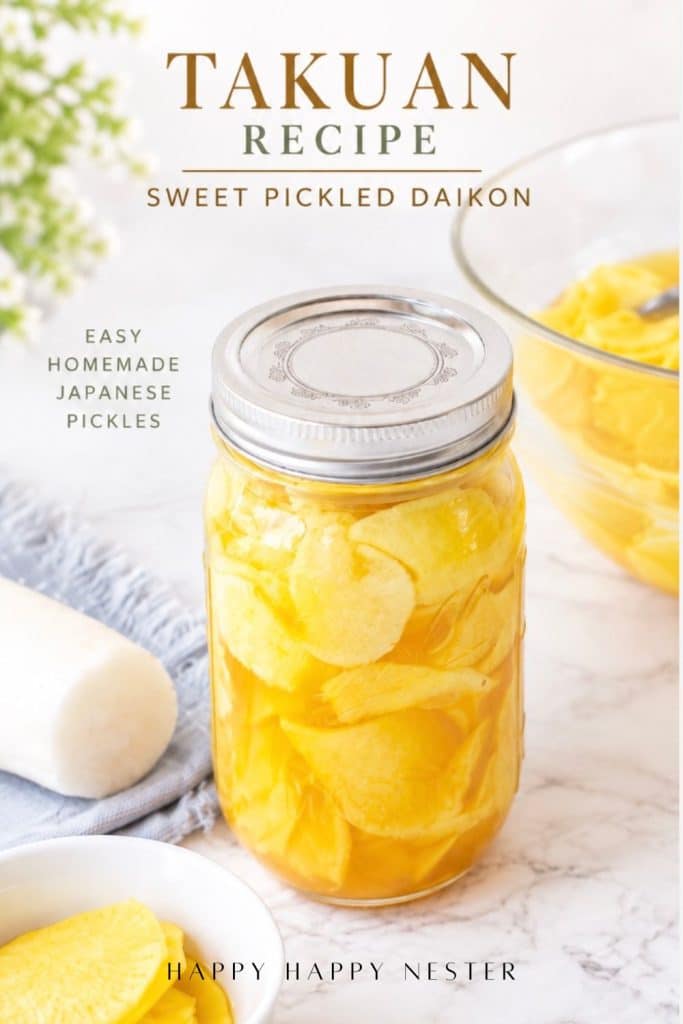
This Takuan Recipe is an easy way to make sweet pickled daikon with the perfect combination of sweet, salty, and tangy flavors. These crunchy Japanese pickles are quick to prepare with vinegar, sugar, and sea salt, and turmeric gives the daikon its beautiful yellow color without food coloring. Serve takuan on its own as a simple side dish or alongside your favorite sushi rolls.
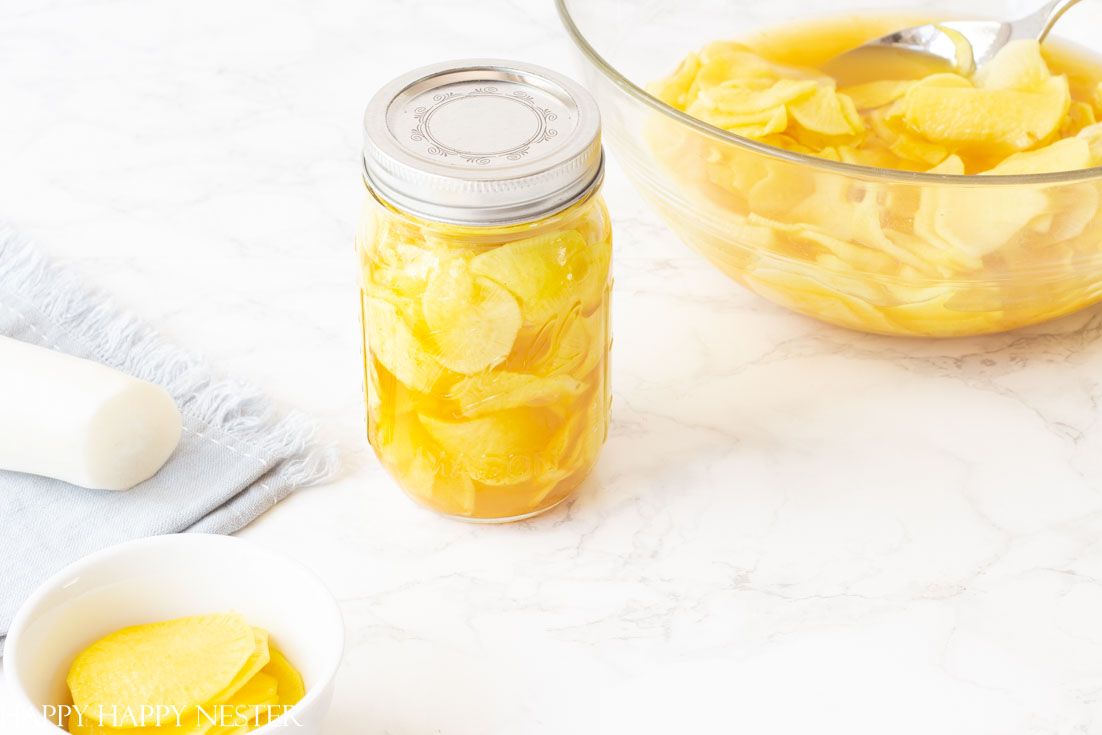
I’m happy to say that I’ve eaten these Japanese pickles for most of my life. My auntie made this sweet pickled daikon and frequently shared jars of it with our family. She was almost like our little grocery store for certain things!
Once my parents moved away and we didn’t see my auntie as often, she kindly passed her original Takuan recipe along to my mom. Eventually, the recipe made its way to me.
This recipe is a little bittersweet to share since my Auntie Emy passed away a few years ago, and I wish she could have seen this post. I’m dedicating it to her as a thank you for all the jars of Takuan she shared with our family over the years—and, of course, for passing along her wonderful recipe.
Ingredients for This Takuan Recipe
Let’s take a closer look at a few of the key ingredients you’ll need to make this sweet pickled daikon.
Japanese Daikon Radish
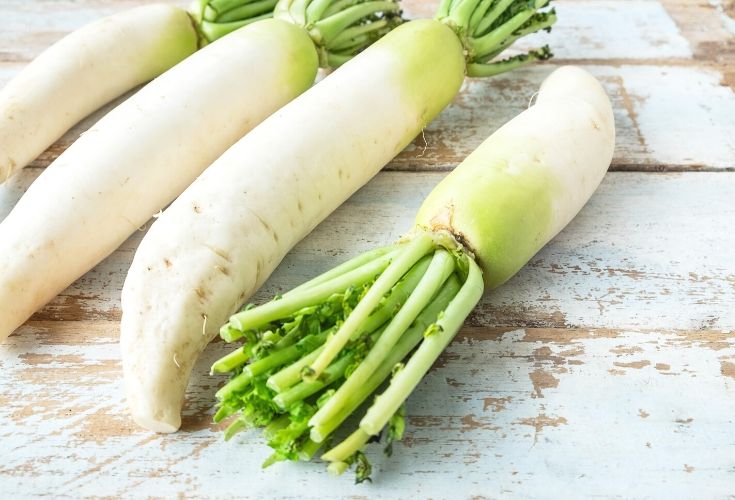
Daikon is a long white radish commonly used in Japanese cooking. It has a mild, slightly sweet flavor and a crisp texture, which makes it perfect for pickling. Look for firm, smooth daikon radishes without soft spots or wrinkled skin.
Turmeric Powder
Turmeric gives these takuan pickles their beautiful yellow color without the need for food coloring. You only need a small amount, so it adds color without overpowering the sweet and tangy flavor of the pickled daikon.
Vinegar
White vinegar gives the daikon its tangy pickled flavor and balances the sweetness of the sugar. You can substitute rice vinegar if you prefer a slightly milder flavor.
Sugar and Sea Salt
Sugar gives this takuan its characteristic sweetness, while sea salt balances the flavor and helps season the daikon. Together with the vinegar, they create the sweet, salty, and tangy flavor I remember from my auntie’s recipe.
What Is Takuan and Tsukemono?
Growing up, my parents called this sweet pickled daikon tsukemono. As a child, I somehow pronounced it “skih-MO-no,” which makes me laugh now! Here’s the simple difference between the two terms.
What Is Tsukemono?
Tsukemono is the Japanese word for pickled foods, especially pickled vegetables. There are many different types of Japanese tsukemono, and they’re commonly served with rice or alongside a meal.
What Is Takuan?
Takuan is a specific type of Japanese pickle made with daikon radish. Traditional takuan is typically made by drying and pickling daikon, often with salt and rice bran, and allowing it to ferment. My auntie’s version is a much quicker, sweeter recipe made with vinegar, sugar, and turmeric.
How to Make Takuan (Pickled Daikon Radish)
Ingredients You’ll Need
- Daikon radish
- Granulated sugar
- White vinegar
- Sea salt
- Ground turmeric
- Two 12-ounce Mason jars
Step 1 – Peel and Slice the Daikon
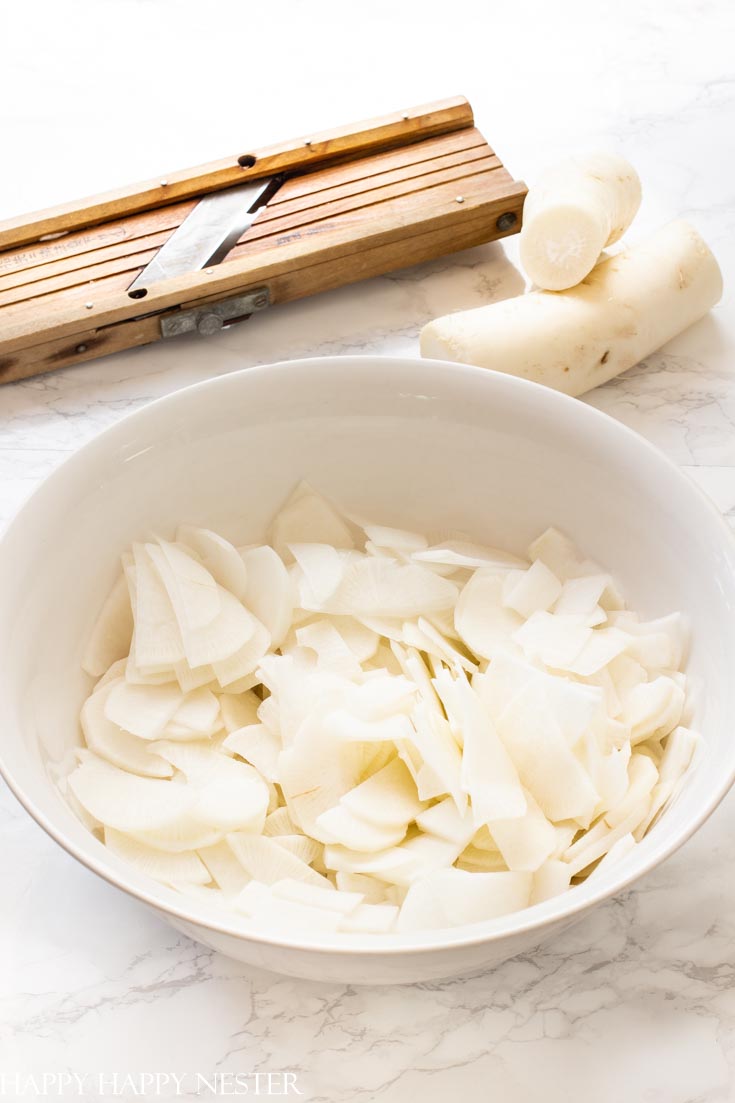
Peel the daikon radish, then use a mandoline or sharp knife to cut it into thin, even slices. Place the sliced daikon in a large bowl.
Step 2 – Make the Pickling Liquid
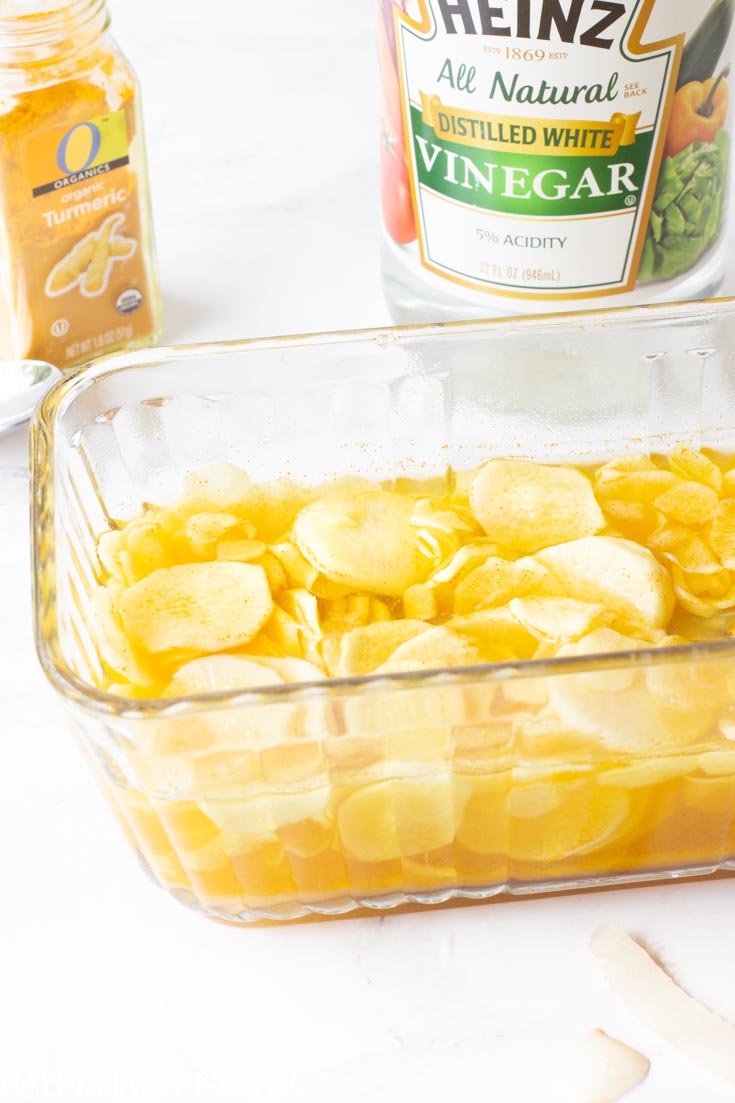
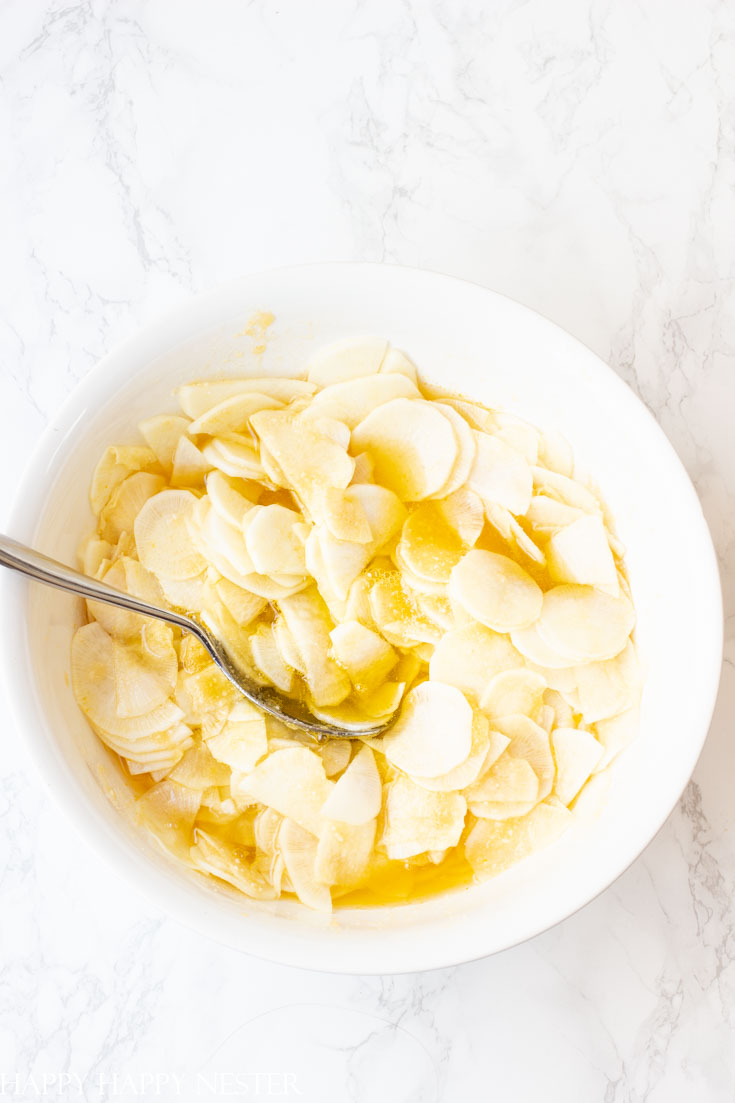
Combine the sugar, salt, vinegar, and ground turmeric. Stir until the sugar and salt are dissolved, then pour the mixture over the sliced daikon.
Step 3 – Let the Daikon Soak
Make sure the daikon slices are coated in the pickling liquid. Cover and let them soak for 2 hours. The Takuan is edible after about 1 hour, but I find the flavor is best after 2 hours.
Step 4 – Transfer to Jars
Pack the daikon slices tightly into two clean 12-ounce Mason jars. Once the jars are filled, add just enough of the pickling liquid to top them off. Cover and store the Takuan in the refrigerator.
Takuan Recipe (Sweet Pickled Daikon)
Ingredients
- 3 ½ pounds daikon radish
- 3 cups sugar
- ⅓ cup salt
- ½ cup vinegar
- 1 tsp turmeric
Instructions
- Prepare the daikon. Peel the daikon radish and slice it thinly with a mandoline or sharp knife. Place the slices in a large bowl.
- Make the pickling mixture. Combine the sugar, salt, vinegar, and turmeric. Stir until the sugar and salt are dissolved.
- Pickle the Daikon: Pour the pickling mixture over the sliced daikon and toss to coat. Cover and let it sit for 2 hours. The Takuan is edible after about 1 hour, but I find the flavor is best after 2 hours.
- Transfer to Jars. Pack the daikon slices tightly into two clean 12-ounce Mason jars. Once the jars are filled, add just enough of the pickling liquid to top them off. Cover and store the Takuan in the refrigerator.
Frequently Asked Questions About Takuan
How Do You Eat Takuan?
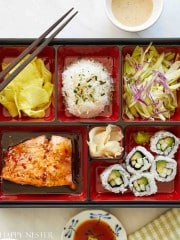
We love serving Takuan with a bowl of warm rice. The sweet, tangy flavor and crunchy texture go especially well with sticky or sushi rice. It’s also delicious alongside Japanese dishes like teriyaki or sushi. And if you’re like me, you may find yourself snacking on these crunchy pickles straight from the jar!
Why Does This Takuan Recipe Use So Much Sugar?
Three cups of sugar may look like a lot, but this recipe starts with 3½ pounds of sliced daikon. At first, there is just enough pickling mixture to coat and cover the daikon. As it sits, the daikon releases water and reduces considerably in volume. When I pack the finished Takuan into the jars, I add the daikon first and then just enough of the pickling liquid to top off each jar. A good amount of the pickling liquid is left behind and isn’t transferred to the jars.
How Do You Know When Takuan Is Ready to Eat?
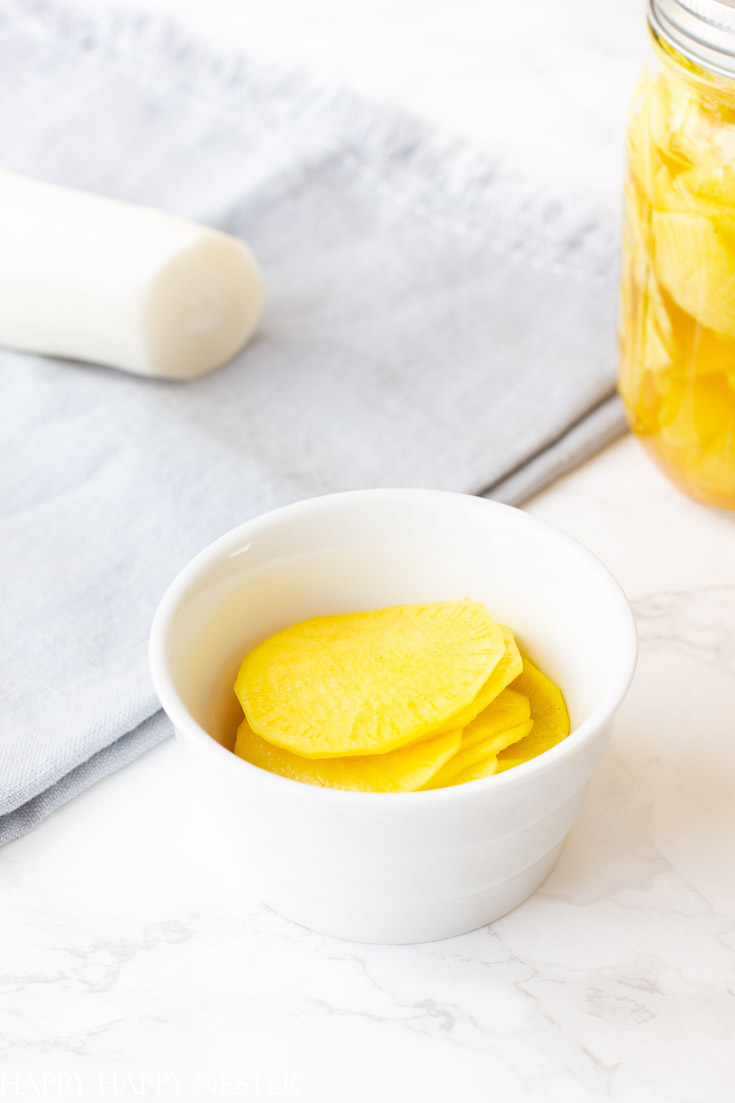
The Takuan is ready to eat after about an hour, but I find the flavor is even better after 2 hours. As the daikon sits in the pickling mixture, it releases water, reduces in volume, and takes on its pretty yellow color from the turmeric.
Why Is Takuan Yellow?
You don’t need artificial food coloring for this recipe. Ground turmeric naturally gives the daikon its beautiful yellow color.
Why Does the Recipe Use So Much Daikon?
Daikon loses some of its volume as it sits in the pickling mixture, so the finished amount won’t look as large as the fresh sliced radish you started with. You can also make a smaller batch if you don’t need a full recipe.
Can I Use Kosher Salt Instead of Sea Salt?
Yes, but the amount may need to be adjusted because different brands and types of kosher salt have different crystal sizes. For the most consistent results, use the sea salt called for in the recipe.
Is Icicle Radish the Same as Daikon?
No. Icicle radish and daikon are both white radishes, but they are different varieties. Daikon is generally larger and has a milder flavor, so I recommend using daikon for this Takuan recipe.
Where Can I Find Daikon Radish?
Japanese and other Asian grocery stores are usually great places to find fresh daikon radish, and they often carry larger ones. You may also find daikon at Whole Foods or in the produce section of a well-stocked grocery store.
How Long Does Takuan Last in the Refrigerator?
Store this Takuan covered in the refrigerator and enjoy it within about 3 to 4 weeks. I’ve noticed that around the 3- to 4-week mark, the daikon begins to darken and doesn’t look as fresh, so I prefer to finish it before then. Always keep the Takuan refrigerated.
How to Slice the Daikon
I still have my grandmother’s old Asian mandoline, and it slices the daikon beautifully thin and even. I have to admit, though, I cringe a little every time I use it because that old mandoline is incredibly sharp!
A modern mandoline makes quick work of slicing 3½ pounds of daikon, but always use the hand guard and follow the manufacturer’s safety instructions. You can also use a sharp knife if you don’t have a mandoline. Try to keep the slices fairly thin and uniform so they pickle evenly.
I Hope You Like Our Family Takuan Recipe!
I almost didn’t share this sweet pickled daikon recipe since it’s a little more unique than many of the recipes on my blog. But when I shared it on my Instagram stories, so many people started talking about Takuan and asked me for the recipe.
I’m so glad I decided to post it. I also love when my brothers ask me for one of our family recipes because now I can simply point them to my blog. It’s pretty special to have all these recipes in one place—almost like a family cookbook that we can continue to pass along.
I hope you enjoy my Auntie Emy’s Takuan Recipe as much as our family has over the years. Thanks so much for stopping by!

More Japanese Recipes You Might Enjoy
Japanese Cucumber Salad (Sunomono) – This light and refreshing cucumber salad has a sweet and tangy vinegar dressing and makes a wonderful Japanese side dish.
Spicy Tuna Roll Recipe – Make your own sushi at home with this easy spicy tuna roll filled with creamy, flavorful tuna.
Tori Karaage Don (Japanese Chicken) – Crispy Japanese-style chicken served over rice makes a delicious and satisfying meal.
Spicy Edamame Recipe – This flavorful edamame is an easy Japanese appetizer or side dish with a little kick.
Easy Mochi Recipe – This soft and chewy Japanese mochi is another family favorite and one of my most popular recipes.


- Cute Halloween Ideas - September 12, 2026
- Costco Pumpkin Pie Recipe (Copycat) - September 10, 2026
- All Things Pumpkin: The Best Pumpkin Products on Amazon - September 9, 2026


Carrie
Thanks for sharing your family recipe. I grew up eating this and still pronounce it wrong. I never thought to make it myself. It will be fun to make this with my kids.
happyhappynester
Hi Carrie,
That is too funny that you pronounced it wrong also! I hope you like our recipe. It is so easy to make!
Gerald
3 cups of sugar?!!
Please tell me this is a typo.
happyhappynester
Maybe try it with less? This is my auntie’s recipe, and I love how it turns out. Let me know how your changes work!
TimO
We also grew up pronouncing it skimono. Funny I immediately scrolled down to see who the author was when I read about your Auntie Emy as I had a great aunt named Emy who we lovingly called Auntie Em.
happyhappynester
Hi Timo,
Oh my goodness, that is so cool you had an Auntie Emy! Well, I hope you have a chance to make the Takuan. Btw, I still love calling it skimono, maybe that is a kid version?!
Cynthia King
How soon can this be eaten? Some recipes say wait days or weeks but I love take an and don’t want to wait that long! Thanks for sharing!
happyhappynester
Hi Cynthia,
I wait a couple of hours! Of course it better the next day, but I can’t wait either! 🙂
Mark Hanaoka
I don’t think that pronunciation is in error… “technically speaking” perhaps, but we still call it “skih-MO-no”; actually we use an additional syllable: “skih-nah-MO-no”. My grandfather was born in Japan, and that’s what he always called it. I don’t speak a lick of Japanese, but I’m thinking maybe that the way we say it applies specifically to pickled diakon, and possibly tsukemono is a more general term that applies to all pickled vegetables? No clue, but I found that interesting that we weren’t the only ones using that term. Anyways, figured I share and say thanks for the recipe!
happyhappynester
Wow, thanks for your comment. So, I guess we pronounced it correctly. I don’t speak Japanese, but I do know the words that a child would know. 🙂 I’m happy you found my blog and shared about your grandfather! My auntie’s recipe is tasty.
By the way, I just made it for our New Year’s celebration. Unfortunately, I could only order three pounds of daikon, so I halved the recipe. It was still tasty. Happy New Year to you and your family!
Mr M
Simple recipe I had to add in a bit more spice to it like peppercorns. Bay leaves cinnamon stick and bird eye chilli with a sprinkle of gochug sprinkle I like my spicy sweet and sour
happyhappynester
Hi Mr. M,
Oh wow, you did spice up the recipe, and I love that! Thanks so much for your amazing rating! We love this recipe, and I always have a jar of it in the fridge!
Wendy
Hi! Could you tell me, what kind of vinegar is better? Thank you in advance and take care about your self
happyhappynester
Hey Wendy,
I use regular Heines Vinegar, it works great!
chris J
Nice recipe, but why do you food bloggers so often provide recipes for pounds and pounds of the resulting product? I make takuan every several weeks in small amounts suitable for my wife and I. You make enough to feed the neighborhood. It would be ‘nice’ if you provided some portion sizes to save us the trouble.
happyhappynester
Hello Chris,
On the recipe you can change the portion levels right next to the word “serving”. This will then allow you to make as much or as little as you would like. Hope that helps!
Barbara C
Thanks for the inspiring recipe. I’ve followed your recipe but eventually evolved mine into this very simple, yummy one. https://barbara4tech.wordpress.com/2021/09/08/recipe-home-made-hawaiian-style-takuan/
happyhappynester
Hello Barbara,
Glad to hear my recipe has inspired you. And thanks for your recipe, can’t wait to try it out.